 3rd international conference on Classroom-oriented research: Reconciling theory and practice
Dates: 14-16 October 2013 Location: Konin, Poland Featured speakers: Anne Burns Jean-Marc Dewaele Elaine Horwitz Hanna Komorowska Norbert Schmitt David Singleton Paul Meara Organisers: Institute of Modern LanguagesState School of Higher Professional Education, Konin, Department of English Studies, Faculty of Pedagogy and Fine Arts, Adam Mickiewicz University, Kalisz and Institute of English Studies, Faculty of Philology, University of Łódź in collaboration with IATEFL Research SIG Further details here: https://sites.google.com/site/classrooomorientedresearch2013/home The scholarship for Research SIG members to attend this conference has been awarded to Alexia Piaggio. More details here  Webinar Follow-up Discussion: 'Researching with Young Learners' Date: 28 January to 8 February 2013 Guest moderator: Shelagh Rixon Location: ReSIG YahooGroup For details of the webinar, please click here Click on the link below to read online or download a copy of Kuchah and Pinter's recent article:
Kuchah, K. & Pinter, A. (2012). 'Was this an interview?' Breaking the power barrier in adult-child interviews in an African context. Issues In Educational Research, 22(3), 283-297. This event is open to ReSIG members and non-members. You can join our YahooGroup for free here. How to participate: - Join our YahooGroup at the link above. if you're not a member yet. - Attend the webinar - please see details here. - Download the article at the link above. - Read the article. - Read the summary of webinar and a few questions below (to be posted shortly after the webinar). The Moderator Shelagh Rixon's early career was with the British Council with administrative, training and teaching roles in varied countries. Between 1991 and 2010 she was a Lecturer then Associate Professor at Warwick University, co-ordinating the MA in ELT for Young Learners. Her interest in the appropriate assessment of Young Learners developed from her interest in appropriate child-friendly pedagogy. She has recently completed a PhD in on pedagogical systems and practices in the early reading instruction of Young Learners of English. With Szilvia Papp, she is co-author of a book for the Cambridge ESOL SiLT series on assessing Young Learners.  Researching with Young Learners Webinar - organised by ReSIG in cooperation with IATEFL Young Learners SIG Date: Sunday, 27 January 2013 Time: 1.30-3.30 pm GMT Presenters: Harry Kuchah Kuchah & Annamaria Pinter Location: IATEFL online conference room LATEST NEWS: The webinar has now finished. A full recording is freely available here (this takes some time to download but is worth the wait!) Follow-up event: There will be a follow-up discussion on our YahooGroup, open to members and non-members. Please click here for further details. The Webinar As adults and teachers, we all have personal and shared opinions about pedagogic practices that can motivate young learners in the language classroom. However, it is rarely suggested that our opinions and practices might be at odds with the opinions and interests of the same learners for whom we develop these practices. While it is common practice to elicit feedback on teaching practices from adult learners, there is still little research in which adult researchers and teachers seek children’s perspectives about the way teaching should happen in their classrooms. In this webinar talk we will be sharing some thoughts about what ‘good practice’ may mean when ‘adult outsiders’ attempt to elicit interview data from children. The talk will start with a discussion about the methodological and ethical dilemmas relevant to interviewing 10-year-old children in elementary schools for research purposes. The context (Cameroon) and the actual procedures of the data collection will be described next, and we will share some of the data and our analysis of it, focussing on the complexities and challenges of interpretation, bringing together both process and product (how the conversation unfolded and what the children actually said). Then we will match children’s perspectives with those of their teachers to show that, while there may be shared perspectives of good teaching practices, adult perspectives of what constitutes good teaching with young learners may not always be enough to rely on. Finally, we will summarise the most important implications for both classroom teachers and researchers working with child subjects. Click on the title of the article below to read it online or download the pdf: Kuchah, K. & Pinter, A. (2012). 'Was this an interview?' Breaking the power barrier in adult-child interviews in an African context. Issues In Educational Research, 22(3), 283-297. The Presenters  Annamaria Pinter is an Associate Professor in the Centre for Applied Linguistics, University of Warwick, UK. She lectures at masters and doctoral levels and supervises theses in the area of teaching languages to children. Her particular interests include task based learning, socio-cultural theory and materials design. She has been involved in teacher development programmes both at Warwick and overseas. She has published widely in the area of teaching English to young learners. She is the author of Teaching Young Language Learners (Oxford University Press (2006)) and Children Learning Second Languages (Palgrave Macmillan (2011).  Harry Kuchah Kuchah has worked for 14 years as ELT teacher trainer and inspector at primary and secondary levels in Cameroon. He is Teaching Fellow in Applied Linguistics in the School of English, University of Sheffield and currently completing his PhD research at the University of Warwick. His interests are in teaching and researching young learners, context-appropriate ELT methodology, teaching large and multi-grade classes, learner autonomy and teacher development. He has published widely about the African ELT context.
 Article Discussion: 'Review of developments in research into English as a Lingua Franca’
Date: 9 - 20 July 2012 Article: 'Review of developments in research into English as a Lingua Franca’, by Jennifer Jenkins, Alessia Cogo and Martin Dewey Guest moderators: Will Baker (University of Southampton), Alessia Cogo (University of Southampton) and Martin Dewey (King’s College London) Location: ReSIG YahooGroup Download article here This event is open to ReSIG members and non-members. You can join our YahooGroup for free here. How to participate: - Join our YahooGroup at the link above. if you're not a member yet. - Download the article at the link above. - Read the article. - To help you get ready for the discussion, here are some possible questions, suggested by our guest moderators, apart from ones you might have of your own: 1. “ELF researchers feel their responsibility is to make current research findings accessible in a way that enables teachers to reconsider their beliefs and practices and make informed decisions about the significance of ELF for their own individual teaching contexts” (p. 306). Do you think this is an appropriate aim for ELF research? Do you think ELF researchers have been successful in doing this? If not, how might ELF research engage more with language teachers? 2. The article comments that language use in ELF communication is highly fluid and does not conform to a pre-defined set of norms (see p. 288-292). What implications does this raise for how teachers approach language in the classroom? What forms of English can or should we teach and how should we teach them? 3. Research indicates that ELF is used to represent and create a range of ‘cultures’ that goes beyond the traditional associations of English with UK and US culture (however these might be defined) (e.g. Baker, 2009, cited on p. 297). What does this mean for the cultural content of English language classrooms? 4. “BELF studies demonstrate that intercultural communication skills rather than NS English correctness are key in BELF contexts, and BELF researchers therefore tend to conclude that communication and accommodation, rather than mastery of NS English forms, should be the focus of business English instruction” (p.299). How do you feel about this conclusion given your own experiences of teaching (business) English? 5. Some of the studies cited in the article report that in ELF situations native speakers of English can be more difficult to understand than non-native speakers (see e.g. Kolocsai 2009, cited p. 302). Why do you think this might be? What consequences does this have for the model of an ‘ideal speaker of English’ that might be adopted? 6. One of the gaps in ELF research highlighted by the article is in writing. What implications, if any, do you think ELF might have for writing and the teaching of writing? 7. “As well as the signaling of non-understanding, the focus of ELF pragmatics research has been on how ELF speakers resolve instances of miscommunication, i.e. the strategies they use to respond to and negotiate an initial possibility of non-understanding.” (p. 293). Can insights from ELF pragmatics inform classroom pedagogy? What kind of pragmatic strategies and skills can be taught for communication in ELF contexts? 8. Discussions of ELF research have often indicated that current language testing is in need of considerable restructuring. What challenges does ELF research present to existing assessment practices? 9. What do you feel are the implications of ELF for pre-service and in-service teacher education? Should ELF be included in the syllabus for teacher training programmes (e.g. on CELTA and/or Delta)? 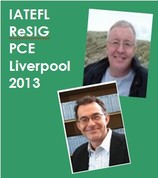 Researching Professional Talk (Pre-Conference Event) Date: 8 April 2013 Presenters: Steve Walsh (Newcastle University) and Steve Mann (Warwick University) Location: Liverpool, UK Further details:
This workshop will examine a range of approaches to collecting and using spoken data as a means of improving professional practice. The focus will be on helping participants to become active reflective practitioners and researchers of their own contexts. There will be an emphasis on data-led approaches which highlight the importance of dialogue and collaboration, our main argument being that most professional activities (including teaching and teacher education) are accomplished through talk. By studying the ways in which we interact, we can gain closer insights into professional practices and professional development. In the session, we’ll be demonstrating how, by using appropriate tools, classroom data, introspection and some kind of dialogue, practitioners can both improve their practices and make their teaching more enjoyable. By using actual data as empirical evidence and by focusing on the interactions which take place in any professional setting, we suggest how we might create active, engaged learning environments. We will cover a variety of contexts, including both language teaching and teacher-training perspectives. The session will cover:
The approach will be very ‘hands-on’ and we’ll be making extensive use of audio and videotaped materials in addition to a range of ‘tools’ specifically designed for class-based research. Steve Walsh is Professor of Applied Linguistics at Newcastle University, and is author of Exploring Classroom Discourse: Language in Action (Routledge, 2011). His book Teacher Development and Classroom Interaction is due to be published by Edinburgh University Press in 2012. Steve Mann is an Associate Professor at the University of Warwick, and is author of Teacher Development: A Discourse for Individual and Group Development (VDM Verlag, 2011). He has previously taught at both Aston University and the University of Birmingham, as well as in Hong Kong, Japan and Europe.  One-Day Workshop: Introduction to Qualitative Research Date: 12 May 2012 Presenter: David Nunan Location: Graz, Austria Registration here. (Online registration closes 27 April) Congratulations to Kashmir Kaur, winner of the ReSIG Scholarship for attending this event. Further details:
Title: Qualitative research in language education Format: One-day seminar consisting of lecture input, presenter-led discussion, and a number of group tasks. Presenter: David Nunan, Ph.D. Emeritus Professor of Applied Linguistics, University of Hong Kong Vice-President for Student Affairs and Dean, Graduate School of Education, Anaheim University, California Overview The aim of this one-day seminar is to explore theoretical and practical aspects of qualitative research in education. There will be three overlapping phases in the seminar. I. The ‘big picture’ In the first part of the seminar we will take a ‘big picture’ look at the research enterprise, discussing and clarifying the following issues and questions:
The focus of this part of the seminar is on qualitative research. We will look in greater depth at the characteristics of qualitative research that differentiate it from quantitative research. We will look at a range of methods for data collection and analysis, including case study, introspection, elicitation and observation. We will also look at ‘mixed methods’ research which, as the name suggests, deploys a range of data collection and analysis methods from both quantitative and qualitative paradigms. III. Developing a research plan In the final part of the workshop, we will look at steps in the process of developing a research plan, and at the pitfalls and possible solutions to the pitfalls that can occur during the research process.  Article Discussion: Language teacher research engagement Date: 12-16 December 2011 Article: Language teacher research engagement, by Simon Borg Guest moderator: Simon Borg, University of Leeds, UK Location: ReSIG YahooGroup Download article here This event is open to ReSIG members and non-members. You can join our YahooGroup for free here. How to participate:
- Join our YahooGroup at the link above. if you're not a member yet. - Download the article at the link above. - Read the article. - To help you get ready for the discussion, here are a few prompts for discussion, suggested by Simon: 1. Are there any claims in the study which either support or contradict your personal experience and/or beliefs? 2. In your context, is it reasonable to expect teachers who are not engaged in formal study to engage with language teaching research? Why or why not? 3. How do you feel about the notion of teachers as consumers of published research? 4. In your context, is it reasonable to expect teachers who are not doing a course (e.g. an MA or Delta) to engage in language teaching research? Why or why not? To what extent do the barriers listed in Table 2 pertain? Are there any others in your context? 5. The article argues that inquiry which is not made public should not be called research. What are your views on this? 6. The literature raises concerns about the quality of the classroom-oriented inquiries that practising teachers often undertake. Is it fair to assess such research using the criteria that apply to research more generally? 7. What role can school leaders or departmental heads play in promoting research engagement in their schools? Do you have any positive or negative experience to cite in this respect? 8. What kinds of initiatives in language teaching might increase the extent to which teachers read and do published research? How might associations such as IATEFL contribute to such initiatives? 9. To what extent do the private EFL sector and the state EFL sector face similar challenges in enabling teachers to engage in and with research? Much less evidence exists about the state sector. 10. Respond, in an open-ended manner, to any others issues in the paper which stimulate a reaction in you. - During the week of 12-16 December, make sure you check the posts on the YahooGroup at least once a day and add your contributions. |
AuthorWelcome to IATEFL ReSIG blog! Archives
September 2015
|
 RSS Feed